Grey Box: a woodland tree worth saving
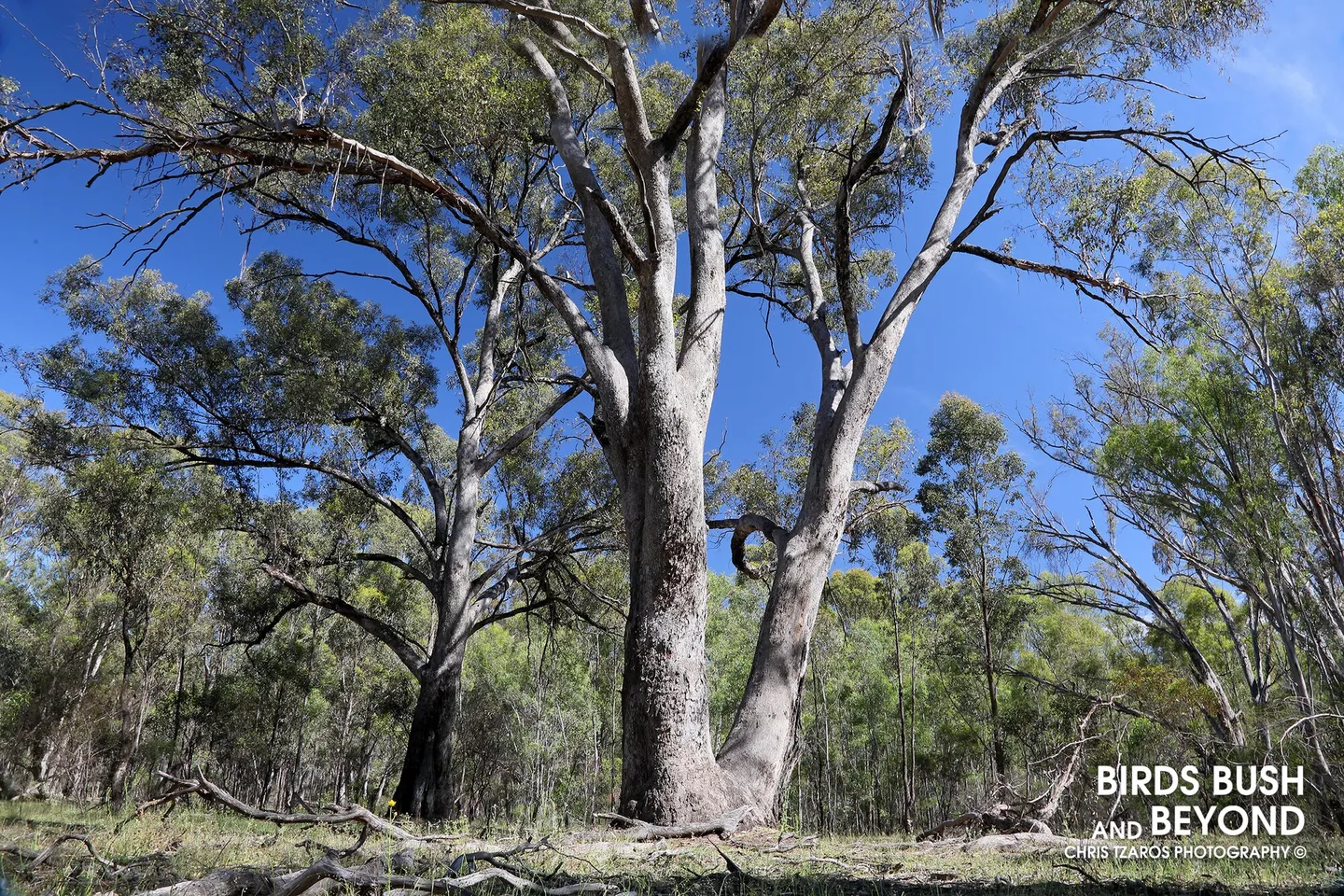
The Grey Box is a native tree that grows locally just above the floodplain, where River Red Gums dominate. It stands out in late summer and early autumn, when it flowers.
How to recognise a Grey Box
The Grey Box is a long-lived, mostly single-stemmed spreading eucalypt growing to 30 m, with finely textured grey bark on the trunk and larger branches, grading to smooth in the upper branches, where it sheds bark in strips. The leaves are olive green and, like all eucalypts, it produces flowers, mostly in late summer and early autumn. The buds and fruits occur in groups of seven, and the buds are barrel-shaped, with valves enclosing the fruit. The flowers are white.
Grey Box woodlands
Grey Box woodlands were widespread on the drier fertile plains of clay-loams and heavy-textured soils, and on stony rises like those around Killawarra and Chiltern. The plains woodlands were open and dominated by native grasses, with few shrubs, whereas on the stony hills shrubs were common underneath. The plains vegetation has mostly been cleared for agriculture, and the best remaining examples are generally found along roadsides.
Cultural importance
Grey Box trees were particularly important for our Traditional Owners, the Bpangerang, who used their bark for making many practical and cultural implements, including coolamons, shields and roofing. There are still many living Bpangerang scarred trees along our roadsides, for example on parts of the Murray Valley Highway and Three Chain Road between Wangaratta and Corowa.
Wildlife that depends on Grey Box
These relict Grey Box woodlands are still very important habitat for many native plant and animal species. The now extremely rare Bush Stone-curlew roosts during the day among fallen branches in small Grey Box woodland plots, from where it forages for insects in the surrounding paddocks. The endangered Grey-crowned Babbler, found between Killawarra and Rutherglen, is heavily reliant on surviving roadside patches and paddock trees of Grey Box for its future survival. Even the Critically Endangered Swift Parrot often prefers Grey Box nectar, or the sap-sucking insects on its leaves, once it arrives in our area in autumn.
If you are walking, riding or driving near Killawarra or Chiltern in late summer, check out these large trees in flower.

Ian Davidson
Ian is the founder of Covram.

Chris Tzaros
Chris runs Birds Bush and Beyond.
Northeast Naturally first appeared as a weekly column in the Wangaratta Chronicle.
Diamond Firetail: diamonds in the rough
The Diamond Firetail is one of the most striking small birds of north-east Victoria's grassy woodlands. How to identify it, why the males with the most spots win, and where to find it in the Warby Ranges and around Eldorado.
Hooded Robin: a special bird of our woodlands
The Hooded Robin is a threatened black and white robin of north-east Victoria's open woodlands. How to tell males from females, what habitat it needs, and where to see it in the Warby Ranges and the Eldorado and Lurg hills.